ASEAN Space Cooperation Gains Momentum as Leaders Eye Declaration on Orbital Safety
- Mar 13
- 3 min read
Summary
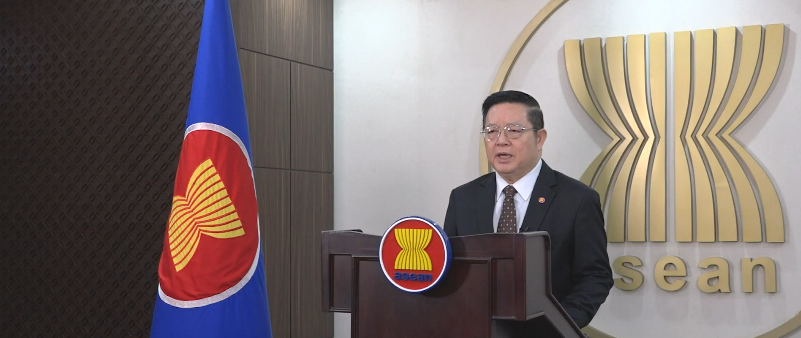
ASEAN Secretary-General Dr. Kao Kim Hourn has called for urgent regional action on space situational awareness (SSA) and space traffic management (STM) to safeguard the growing number of satellites critical to disaster response, connectivity and economic resilience. In a pre-recorded keynote at the ASEAN SSA and STM Seminar in Manila on 12 March 2026, he urged stakeholders to turn dialogue into concrete steps feeding into an anticipated ASEAN Leaders’ Declaration on Space Cooperation at this year’s Summit. The seminar, jointly hosted by the Philippine Space Agency, Thailand’s Geo-Informatics and Space Technology Development Agency, and the United Nations Office for Outer Space Affairs (UNOOSA), underscores ASEAN’s push to treat space as strategic infrastructure amid rising orbital congestion.
Recount of Events
Delivering a pre-recorded keynote at the ASEAN SSA and STM Seminar in Manila, ASEAN Secretary-General Dr. Kao Kim Hourn highlighted the rapid transformation of Earth’s orbital environment.
He noted that more than 36,000 large debris objects, one million coin-sized fragments, and over 130 million tiny shards now circle the planet, alongside roughly 14,000 active satellites — nearly double the 7,500 in 2023. Space controllers issue thousands of collision warnings daily, while annual launches have surged into the thousands. Recent solar storms further demonstrated how orbital disruptions can cascade to ground-level impacts, including communications blackouts and power outages.
For ASEAN, with 684 million people and high exposure to natural disasters, satellite data is essential infrastructure. Dr. Kao cited the Cospas-Sarsat system’s role in rescuing over 64,000 people and the ASEAN Coordinating Centre for Humanitarian Assistance on Disaster Management (AHA Centre)’s reliance on satellites for hazard tracking and recovery planning. Space-based services also underpin connectivity, aviation and shipping corridors vital to the region.
ASEAN’s engagement with space technology dates to 1999 through the Committee on Science, Technology and Innovation (COSTI) Sub-Committee on Space Technology and Applications (SCOSA). Recent steps include declaring space a priority under the ASEAN Plan of Action on Science, Technology and Innovation 2026–2035 and the ASEAN Economic Community Strategic Plan 2026–2030. The Sub-Committee on Earth, Ocean and Space Science (SC-EOSS) has streamlined coordination across related disciplines, supported by four ASEAN Centres focused on space, meteorology, earthquakes and weather modification.
Ongoing initiatives include the ASEAN–India Space Cooperation Programme, with a telemetry station in Biak, Indonesia, and a data facility in Ho Chi Minh City, Vietnam, both due for completion in 2029. The region’s space economy is projected to contribute significantly to gross domestic product (GDP) by 2030, aligning with ambitions for a USD 2 trillion digital economy under the ASEAN Digital Economy Framework Agreement (DEFA).
Dr. Kao called for these efforts to culminate in the ASEAN Leaders’ Declaration on Space Cooperation at this year’s Summit, formalising responsible governance and real-time data sharing to prevent collisions and ensure sustainable orbital use.
Analysis
From an Indonesian vantage point, Dr. Kao’s message resonates deeply: space is no longer a distant frontier but essential infrastructure that underpins our disaster response, connectivity and economic competitiveness. Indonesia, with its vast archipelago and frequent exposure to natural hazards, relies heavily on satellite data for early warning, monitoring and recovery — much like how the AHA Centre draws on these tools to coordinate across borders. Losing access or facing disruptions in orbit would directly hit lives, supply chains and regional stability.
The push for an ASEAN Leaders’ Declaration on Space Cooperation is a timely step. ASEAN already has a strong foundation through SCOSA and SC-EOSS, but rising orbital congestion demands a more formal, binding framework — especially as satellite numbers double and collision risks multiply. For Indonesian firms in agriculture, fisheries, logistics and digital services, reliable SSA and STM mean fewer disruptions to operations that depend on navigation, weather forecasting and real-time tracking.
Yet the path forward requires more than declarations. ASEAN must accelerate concrete actions: harmonised data-sharing protocols, joint capacity-building for smaller member states, and alignment with global norms to avoid fragmentation. The ASEAN–India projects in Biak and Ho Chi Minh City are promising anchors, but scaling them regionally will demand sustained investment and political will.
The stakes are high. A congested, unmanaged orbit risks turning space from an enabler of growth into a liability — particularly for a region aiming to become the world’s fourth-largest economy by 2030. If ASEAN can translate this seminar’s dialogue into a robust declaration and follow-through mechanisms, it would not only protect critical services but also position the bloc as a responsible player in global space governance. The window to act is narrow; the cost of delay could be measured in lost lives, disrupted trade and diminished resilience.


